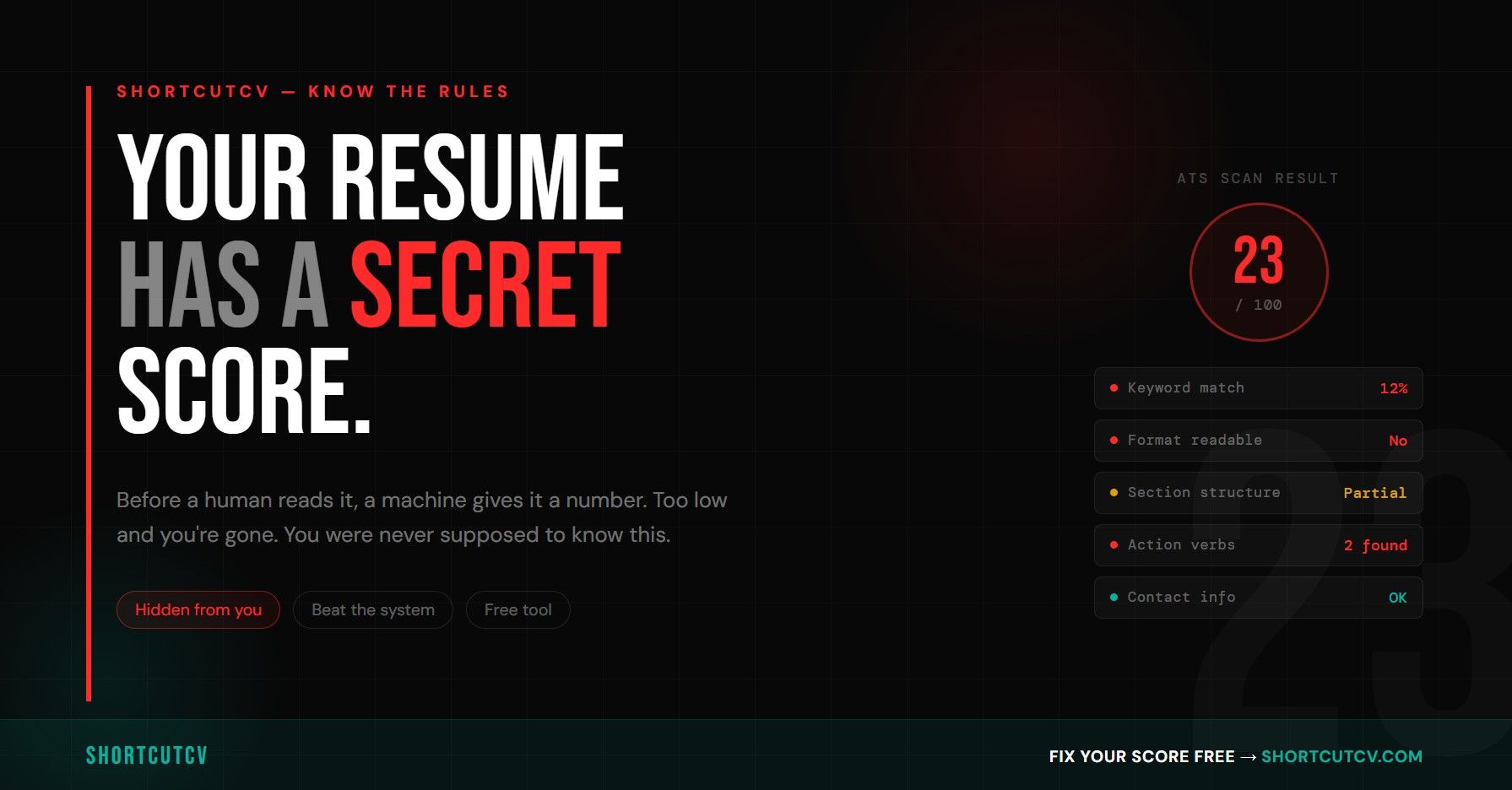
Your Resume Has a Secret Score. You Were Never Supposed to Know.
Your Resume Has a Secret Score. You Were Never Supposed to Know.
When you send your resume to a company, something happens before any human sees it.
A machine reads it. It looks for specific things. It gives your resume a number.
That number is your score. And if your score is too low, you are deleted before a recruiter ever opens your file.
You were never supposed to know this. The companies that sell this software do not advertise it to job seekers. The companies that use it do not mention it in their job postings.
But it is real. And it is happening to your resume right now.
What the Score Is Made Of
The ATS does not read your resume the way a human does. It does not care about your story. It does not notice that you held a team together through a difficult period or that you learned three new skills in six months.
It is looking for a match.
It takes the job posting and pulls out the important words. The job title. The required skills. The years of experience. The qualifications. Then it looks for those same words in your resume.
Every match adds to your score. Every missing word lowers it.
Here is what most people do not know: the machine is looking for exact matches, not meaning.
The job posting says "project management." Your resume says "led projects." To a human, those mean the same thing. To the machine, they do not match. Your score goes down.
The job posting says "Microsoft Excel." Your resume says "spreadsheets." No match. Score goes down.
The job posting says "customer service." Your resume says "client relations." No match. Score goes down.
You could be the best person for the job. If the words are not there, the score says no.
The Things That Tank Your Score Fast
Beyond keywords, the ATS is also looking at structure. And some very common resume choices destroy your score before the keyword check even starts.
Tables and columns. Many people use a two-column resume layout because it looks clean and professional. Most ATS systems cannot read columns properly. They scramble the text, mix up dates with job titles, and read your skills section as part of your education. The whole document becomes noise.
Headers and footers. If you put your name and contact details in the document header, many ATS systems skip it entirely. Your own name might not appear in the parsed version of your resume.
Images and icons. Design resumes with icons for skills or a small headshot are very popular. The ATS sees them as blank space or errors. Everything around them gets confused.
Unusual section names. If you call your work history "My Journey" instead of "Experience," the machine does not know what it is looking at. Standard section names — Experience, Education, Skills — are what the system is built to find.
PDFs from design tools. A resume exported from Canva or Adobe looks beautiful. The text inside is often stored as image data, not readable text. The ATS scans it and finds nothing.
They Score You Without Telling You
The companies that use these systems — big employers, banks, hospitals, tech firms, retailers — pay thousands of pounds or dollars a month for this software.
It is a significant investment. They do not advertise it because they do not want candidates gaming the system.
But here is the thing: knowing this information is not gaming the system. It is just knowing how the system works. And it should not be a secret.
The rules of the game exist. You were just never given the rulebook.
The Score Is Not About Your Ability
This is the part that should make you angry.
The score does not measure whether you can do the job. It measures whether your resume matches a template. A template that was usually written by someone in HR who copied language from the last job posting, which was copied from the one before that.
Experienced professionals get screened out because they used different words. Recent graduates get screened out because their academic language does not match corporate language. People who moved from another country get screened out because their resume follows a different format.
The machine does not know any of this. It just gives you a number.
You Can Beat It
The score is not random. It has rules. And rules can be learned.
The keywords come from the job posting — so put those exact keywords in your resume. The structure needs to be ATS-readable — so use a single column, standard section names, and a clean font. The file needs to be text-based — so export as a standard PDF or Word document, not an image.
This is exactly what ShortcutCV does.
You paste in the job posting. The AI reads it, pulls out the keywords, and rewrites your resume to match them. It uses the right structure. It uses the right language. It gives your resume the best possible chance of passing the score.
For free. No account. No subscription. Takes five minutes.
Know the Rules. Beat the Score.
The machine was built to filter you out efficiently.
Now you know how it works.
Build a resume that beats the score — ShortcutCV is free, no sign-up
ShortcutCV is a free, AI-powered resume builder. 36 languages. 16 professional templates. No sign-up required.
Enjoyed this article?
Help keep ShortcutCV free.